Household Clustering & Multi-Member Entities
In many consumer sectors—such as home improvement, automotive, retail, and B2B subscriptions—purchasing decisions involve multiple individuals sharing a physical domicile, corporate budget, or family plan.
Keystone's Household Clustering engine identifies, links, and aggregates multi-member entities without corrupting individual personal identity graphs.
The Household Entity Model
While an individual customer represents a single human identity, a Household is a higher-order cluster grouping related individuals.
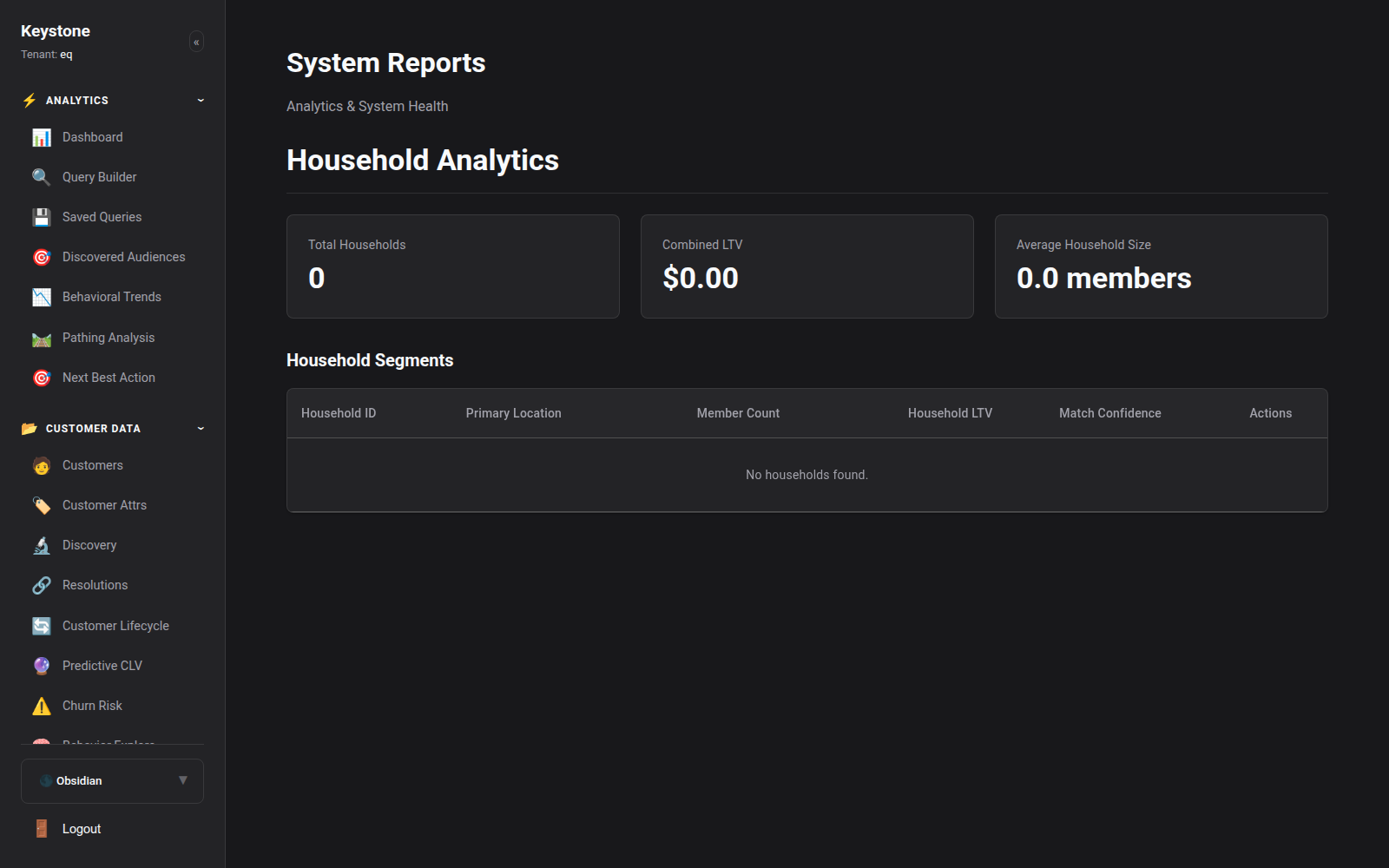
Key Household Attributes
- Household UUID: Canonical cluster identifier.
- Combined Lifetime Value: Aggregated gross revenue across all associated family/team members.
- Primary Contact: The member with the highest engagement score or historical order volume.
- Member Roster: All associated individual customer profiles.
- Shared Delivery Addresses: Validated physical postal addresses associated with the cluster.
Clustering Algorithms
Keystone uses a multi-tier clustering algorithm to establish household connections:
1. Physical Address Normalization
Delivery addresses submitted during e-commerce checkout or billing forms are parsed, USPS-standardized, and hashed: - Street number and street name - Apartment / Suite number - Postal code and country code
When two distinct customer profiles share an identical physical address hash and last name or joint credit billing, they are candidates for household linkage.
2. IP Subnet Clustering
Multiple devices operating continuously behind the same residential or commercial local area network (LAN) submit consistent public IP blocks. Keystone cross-references recurring residential IP sessions with shared e-commerce orders to establish household confidence scores.
3. Explicit Declarations
Customer-facing intake forms, loyalty account sharing, or enterprise seat invitations explicitly map members to a shared account structure.
Household-Level Marketing & Activations
Household clustering provides powerful optimization for outbound marketing: - Frequency Capping: Avoid sending redundant direct mail catalogs or repetitive email promotions to four different family members in the same living room. - Household LTV Tiering: Identify high-value affluent households whose individual members might each look like mid-tier spenders in isolation. - Cross-Member Recommendations: Recommend complementary products (e.g. accessories or refills) based on items purchased by other members of the household.