Product Velocity & Pareto ABC Analysis
Not all products contribute equally to business performance. Keystone's Product Velocity engine tracks inventory movement speed and applies Pareto ABC classification to guide merchandising decisions and stock allocations.
1. Product Velocity Dashboard
Navigate to Products -> Product Velocity (/products/velocity) to inspect sales speed metrics across your catalog.
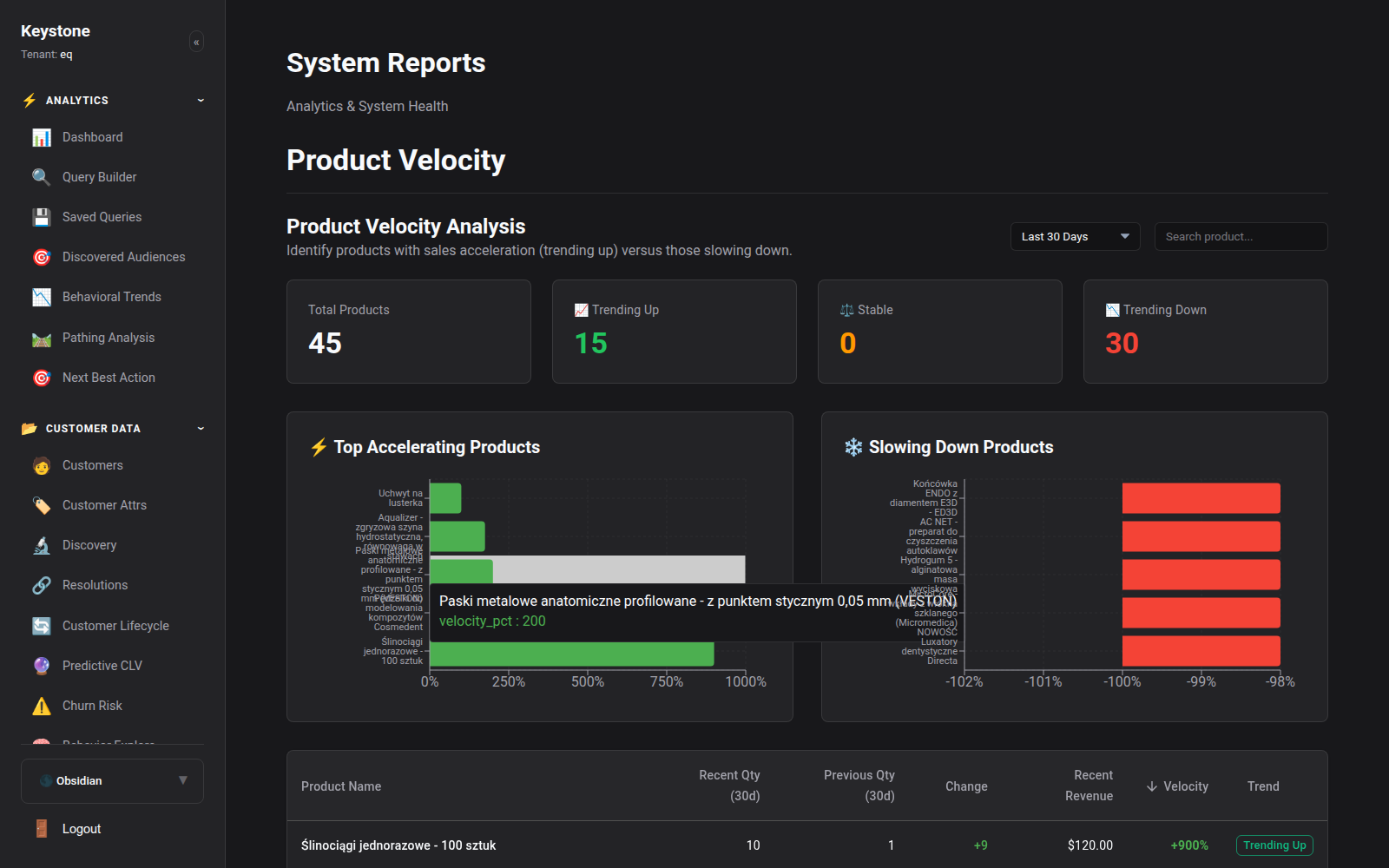
Key Velocity Metrics:
- Daily Run Rate: Average units sold per calendar day over rolling 7, 30, and 90-day windows.
- Velocity Acceleration: Week-over-week rate of change in purchase frequency (+18% momentum vs -12% deceleration).
- Days of Inventory Remaining: Predictive calculation cross-referencing on-hand inventory with current daily run rate.
2. Pareto ABC Classification
Keystone classifies your entire catalog into three distinct revenue tiers based on the Pareto Principle (80/20 rule):
pie title Catalog Revenue Contribution
    "Tier A (Top 80% Revenue)" : 80
    "Tier B (Next 15% Revenue)" : 15
    "Tier C (Tail 5% Revenue)" : 5
The Three Tiers:
- Tier A (Flagship Drivers): Typically 15-20% of your SKUs that generate 80% of your gross revenue.
- Strategy: Guarantee 100% in-stock availability; prioritize in paid acquisition hero campaigns.
- Tier B (Steady Mid-Tier): SKUs contributing the next 15% of revenue.
- Strategy: Target for cross-selling and bundling with Tier A products.
- Tier C (Long-Tail / Stagnant): The remaining 50-60% of SKUs that generate only 5% of total sales.
- Strategy: Review for clearance markdowns, bundle incentives, or discontinuation.
3. Merchandising Alerts
The velocity engine triggers automated operational alerts: - Stockout Warning: Alerts inventory managers when a Tier A product has fewer than 14 days of inventory remaining. - Sudden Surge Detected: Notifies marketing when an unpromoted product begins trending virally on social media or search. - Dead Stock Alert: Highlights Tier C inventory with zero sales in the past 60 days.