Keystone CDP - Platform Overview
Keystone Customer Data Platform (CDP) is an enterprise-grade customer intelligence and activation engine engineered specifically for rapid ingestion loops, real-time identity graph unification, and vector-based attribution.
Executive Summary
Most modern organizations struggle with siloed, fragmented customer data: anonymous web visits on one domain, disconnected e-commerce transactions, point-of-sale records, and disjointed CRM records. Keystone acts as the central nervous system that brings cohesion to this chaos.
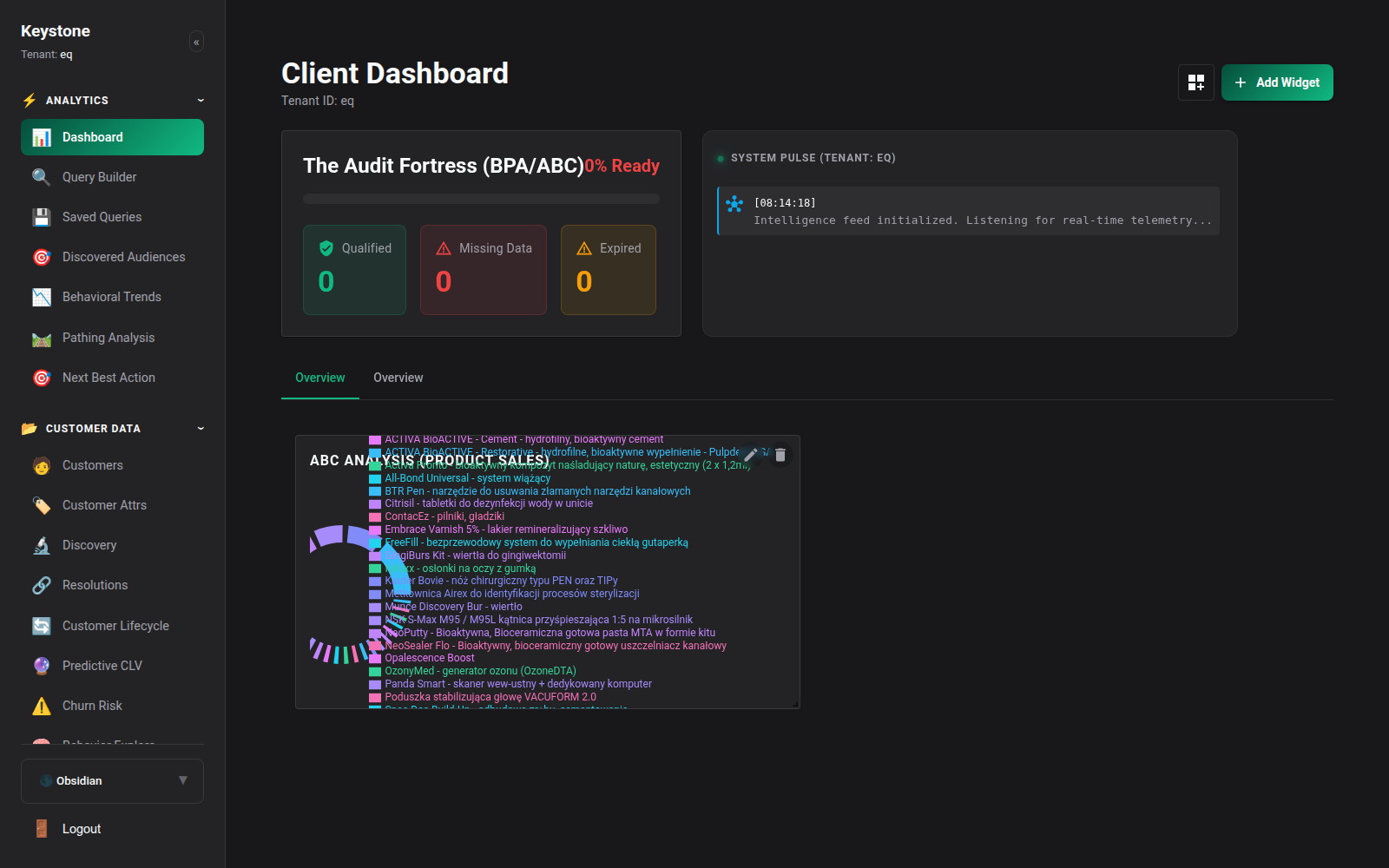
Keystone ingests event streams in real-time, builds a deterministic and probabilistic identity graph across touchpoints, computes predictive machine learning scores (Customer Lifetime Value, Churn Propensity, Next Best Action), and activates audiences across advertising channels, marketing automation tools, and external APIs.
Core Architectural Philosophies
Keystone was architected from the ground up to solve the three core failure modes of legacy CDPs: rigid schemas, brittle identity joins, and opaque attribution models.
1. Schemaless Ingestion (JSONB + Dynamic Enforcement)
Customer data evolves rapidly. Instead of forcing rigid SQL column definitions that break ingestion pipelines whenever a frontend property changes, Keystone combines PostgreSQL JSONB flexibility with real-time schema discovery. Data is accepted instantly and normalized dynamically.
2. The Anchor & Shadow Identity Model
Identity is fluid. A visitor begins as an anonymous cookie ID, signs up with an email address, completes a checkout with a phone number, and subsequently browses from a mobile app.
Keystone maintains: - Shadow Profiles: Temporary, lightweight identity nodes that capture early behavioral events prior to explicit authentication. - Anchor Profiles: Canonical, verified profile entities that represent the customer's permanent record. - The Collapse Protocol: When an anonymous session provides authenticated credentials, Keystone deterministically collapses the shadow profile and its entire historical event graph into the anchor profile without data loss.
3. Vector-Based Trajectory Attribution
Traditional single-touch models (First-Touch, Last-Touch) and arbitrary linear heuristics fail to account for multi-channel purchase paths. Keystone transforms multi-event customer touchpoint sequences into 1536-dimensional vector trajectories in a shared latent space, computing geometric similarity between marketing touchpoints and final purchase conversions.
4. Micro-Batch & Queue Optimization
Real-time ingestion pipelines must never block client requests. Keystone uses asynchronous Redis queues with ARQ worker pools to decouple ingestion acceptance from background enrichment, ML feature extraction, and third-party activations.
Obfuscated Incognito Mode
Keystone includes an enterprise privacy feature designed for client demonstrations, public documentation, and compliance auditing: Obfuscated Incognito Mode.
All visual exhibits and walkthroughs throughout this documentation site are captured directly from live production systems running under Keystone's Obfuscated Incognito Mode (admin_incognito role).
When authenticated in Incognito Mode:
- Customer Names: Deterministically replaced with synthetic names from an anonymized dictionary.
- Email Addresses: Automatically hashed and masked with @dummy-obfuscated.com domains.
- Phone Numbers & Addresses: Mapped to standardized fictitious phone numbers and addresses.
- Corporate Entities: Employer and B2B account names are redacted.
This allows full platform documentation and operational training without exposing customer Personally Identifiable Information (PII).
System Navigation & Workspace Modules
Keystone CDP is organized into seven operational modules accessible via the navigation sidebar:
| Module | Core Features | Key Capabilities |
|---|---|---|
| Customer 360 | Profiles, Identity Graph, Households | Unified timeline, synthesized traits, subscription analytics, cross-device stitching. |
| Segmentation | Segment Builder, Visual Query, AI Discovery | Real-time cohort calculation, RFM matrix, automated behavioral audience discovery. |
| Predictive AI | Predictive CLV, Churn Risk, Next Best Action | Ridge regression monetary forecasting, churn scoring, collaborative filtering recommendations. |
| Journeys & Pathing | Pathing Analysis, Workflow Builder, Funnels | Multi-touch Sankey journey visualization, drag-and-drop journey automation, funnel step drop-offs. |
| Commerce Intelligence | Product Catalog, Order Analysis, Velocity | SKU hierarchies, basket affinity, Pareto ABC product velocity classification. |
| Activations | Destination Connectors, Webhook Dispatch | Real-time synchronization to Shopify, Meta Ads, Google Ads, Klaviyo, Mailchimp. |
| Operations & Security | Ingestion Monitor, System Pulse, Audit Fortress | Live WebSocket event stream, BPA/ABC compliance validation, RBAC, domain security. |
Next Steps
- Proceed to the Quickstart Guide to log in and explore your workspace in 5 minutes.
- Learn about the underlying System Architecture.
- Integrate your web application using the JavaScript Tracker SDK.